Lending

Lending protocols form the backbone of the decentralized money market, allowing users to lend or borrow digital assets without intermediaries. Using smart contracts, platforms like Aave and Morpho automate interest rates based on supply and demand while requiring over-collateralization for security. The 2026 lending landscape features advanced permissionless vaults and institutional-grade credit lines. This tag covers the evolution of capital efficiency, liquidations, and the integration of diverse collateral types, including LSTs and tokenized RWAs.

16025 Articles
Created: 2026/02/02 18:52
Updated: 2026/02/02 18:52
Stable Layer-1 Launches Dec 8 with USDT Gas & Real Yield

Stable Layer-1 Launches Dec 8 with USDT Gas & Real Yield

The post Stable Layer-1 Launches Dec 8 with USDT Gas & Real Yield appeared on BitcoinEthereumNews.com. Bitfinex-backed Stable unveils STABLE tokenomics ahead of Dec. 8 mainnet launch. STABLE powers governance and network security; all transactions settle in USDT. Phase 2 pre-deposit campaign raised $1.1B from 10,000+ wallets after whale-limit adjustments. The Stable blockchain, a high-throughput Layer-1 network incubated by Bitfinex and Tether, confirmed Tuesday it will activate its mainnet on December 8 at 8:00 a.m. and has released the full tokenomics of its native STABLE token.  According to the announcement, the STABLE token seeks to bolster both the governance and security of the network. The network itself aims to process high-volume stablecoin transactions. With a fixed supply of 100 billion, STABLE will power the network’s delegated proof-of-stake system, StableBFT. Token holders can delegate stakes to validators, forming what the team calls a “meaningful economic commitment” that helps secure the network. Holders will also participate directly in protocol governance to vote on upgrades, ecosystem fund allocations, and major protocol decisions. Importantly, STABLE will not function as a payment asset. All on-chain transactions will continue to settle in USDT. This eliminates the need for users to hold STABLE for routine network activity. The token’s role is strictly for security, governance, incentives, and long-term ecosystem coordination. Related: Bitfinex Lending Rates Surge to 30% APR: Bullish Signal Bitcoin and Crypto? Token Allocation: 10% for Genesis, No Inflation, USDT-Based Rewards Stable detailed how the 100 billion-token supply will be distributed: 10% — Genesis distribution to bootstrap liquidity and community engagement 40% — Developer grants and partnerships 25% — Team (1-year cliff, 4-year vesting) 25% — Early investors (1-year cliff, 4-year vesting) The network stressed that no inflationary emissions are planned. Instead of minting new tokens, staking rewards will come from USDT-denominated network fees collected into a protocol vault and shared with delegators. Mainnet Rollout With tokenomics now public, Stable said it…

Author: BitcoinEthereumNews
Mauritius to introduce electronic travel authorisation amid surge in tourists

Mauritius to introduce electronic travel authorisation amid surge in tourists

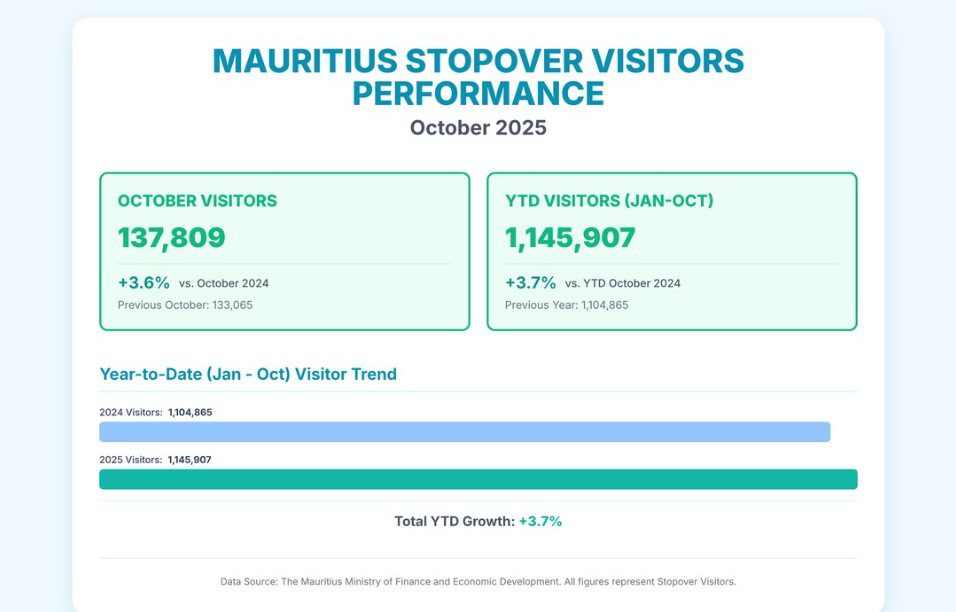
Mauritius is set to introduce an Electronic Travel Authorisation (ETA) to streamline and modernise border clearance for travellers.…

Author: Technext
Solana (SOL) Price Builds Momentum Toward a Potential Breakout, but This $0.035 DeFi Crypto Could Rally Harder

Solana (SOL) Price Builds Momentum Toward a Potential Breakout, but This $0.035 DeFi Crypto Could Rally Harder

Solana (SOL) starts to regain momentum with bullish forces slowly building up once more, while market players eagerly await a breakout following weeks of ranging action. The robust fundamentals of this blockchain project, together with fast transaction capability and increasing developer engagement, keep pushing SOL’s positive momentum upward despite its tightly compressed market performance below […]

Author: Cryptopolitan
PayPal’s PYUSD Stablecoin Grows to $3.8B Amid LayerZero Expansion and Yield Regulation Questions

PayPal’s PYUSD Stablecoin Grows to $3.8B Amid LayerZero Expansion and Yield Regulation Questions

The post PayPal’s PYUSD Stablecoin Grows to $3.8B Amid LayerZero Expansion and Yield Regulation Questions appeared on BitcoinEthereumNews.com. PayPal’s PYUSD stablecoin has experienced rapid growth, surging from $1.2 billion in September to $3.8 billion in market capitalization by Q4 2025, driven by supply increases and blockchain expansions. This positions it as the second-fastest growing stablecoin in Q3, behind Ethena’s USDe. PYUSD supply grew 113% in November 2025, with transactions rising 150% to 1.8 million. Integration with LayerZero enabled expansion to nine blockchains, enhancing accessibility for over 400 million users. The stablecoin’s 3.7% yield has sparked regulatory concerns under the GENIUS Act, which bans yield-bearing options. Discover how PayPal’s PYUSD stablecoin has doubled its market cap to $3.8 billion amid blockchain expansions and regulatory hurdles. Explore growth drivers and market implications for crypto investors today. What is driving the rapid growth of PayPal’s PYUSD stablecoin? PayPal’s PYUSD stablecoin has seen explosive expansion, with its market capitalization climbing from approximately $1.2 billion in September 2025 to around $3.8 billion by the end of Q4, according to on-chain data from DeFiLlama. This surge follows a 113% increase in supply during November, coupled with a 150% uptick in transactions reaching 1.8 million. Key factors include strategic integrations and PayPal’s vast user network, which have accelerated adoption despite the stablecoin’s relative youth compared to established players like USDT and USDC. How has LayerZero integration impacted PYUSD’s multichain presence? The integration with LayerZero in September 2025 has been pivotal for PYUSD stablecoin, allowing it to bridge across nine additional blockchains such as Abstract, Aptos, Avalanche, Ink, Sei, Stable, and Tron, along with enhanced versions on Berachain and Flow. This move has provided direct access to PayPal and Venmo’s combined user base of over 400 million active accounts, facilitating seamless transfers between traditional and decentralized finance ecosystems. On-chain metrics from DeFiLlama indicate that PYUSD’s supply doubled in Q4, underscoring the effectiveness of this multichain approach…

Author: BitcoinEthereumNews
BTC staking platform Babylon teams up with Aave for Bitcoin-backed DeFi insurance

BTC staking platform Babylon teams up with Aave for Bitcoin-backed DeFi insurance

Babylon and Aave partner to enable native BTC as collateral for DeFi lending. BTC can now back decentralised insurance pools, earning yield if unused. Users retain full control of their Bitcoin while accessing DeFi liquidity. In a groundbreaking move for the decentralised finance (DeFi) ecosystem, Bitcoin staking platform Babylon has announced a partnership with Aave, […] The post BTC staking platform Babylon teams up with Aave for Bitcoin-backed DeFi insurance appeared first on CoinJournal.

Author: Coin Journal
Firelight Brings XRP Staking to Flare

Firelight Brings XRP Staking to Flare

Firelight just launched stXRP on Flare, giving XRP holders a new way into DeFi.

Author: Crypto Ticker
EXCLUSIVE: “Follow the Yellow Brick Code” – Carmela Gómez, BBVA in The Fintech Magazine

EXCLUSIVE: “Follow the Yellow Brick Code” – Carmela Gómez, BBVA in The Fintech Magazine

BBVA was determined to find its own way across the new financial landscape by embracing […] The post EXCLUSIVE: “Follow the Yellow Brick Code” – Carmela Gómez, BBVA in The Fintech Magazine appeared first on FF News | Fintech Finance.

Author: ffnews
Rallies 14% as Bybit, Mantle Integration Connects DeFi Lender to 70M Users

Rallies 14% as Bybit, Mantle Integration Connects DeFi Lender to 70M Users

The post Rallies 14% as Bybit, Mantle Integration Connects DeFi Lender to 70M Users appeared on BitcoinEthereumNews.com. Aave’s native token AAVE surged 14% over the past 24 hours to $188 on Tuesday as the broader crypto market rebounded from the steep early week sell-off. The move marked one of the strongest daily gains among major DeFi assets, outpacing the CoinDesk 5 Index’s 8% gain during the same period. The rally was fueled by a sharp breakout above the $175 level during the U.S. trading session, where volume spiked 295% above average in a single hour, CoinDesk Research’s technical analysis tool noted. Overall, AAVE posted an intraday range of $24.90, rising from $164.28 due to strong trading activity, representing a 35.66% increase compared to its seven-day average. Technical indicators confirmed the momentum. AAVE logged three higher lows before pushing above $183.80 support and reaching a session high of $188.26, with volume spikes reinforcing bullish control. Boosting sentiment was Aave expanding to Mantle (MNT), a layer-2 Ethereum scaling network tightly connected to crypto exchange Bybit’s 70 million user base. The partnership brings DeFi lending to a broader audience, leveraging low-cost infrastructure while connecting centralized exchange liquidity with decentralized lending markets. “By bringing Aave’s lending markets to Mantle’s high-performance network with direct access to Bybit’s exchange, this integration makes transparent, onchain finance available at global scale for institutions worldwide,” said Stani Kulechov, founder of Aave Labs. Key technical levels to watch Support/Resistance: Immediate support sitting at $183.80; next resistance at the $190.00 psychological level. Volume Analysis: Breakout confirmed by 35.66% increase in trading volume, signals strong participation. Chart Patterns: Ascending trend with clean breakout above $175 suggests continued strength. Targets & Risk/Reward: Next upside target sits at $190.00 with a potential extension to $195.00; downside risk remains limited while holding above $183.80. Disclaimer: Parts of this article were generated with the assistance from AI tools and reviewed by our editorial…

Author: BitcoinEthereumNews
Firelight Finance debuts xrp staking protocol on Flare with stXRP powering DeFi cover

Firelight Finance debuts xrp staking protocol on Flare with stXRP powering DeFi cover

Firelight launches xrp staking on Flare with stXRP, backing a DeFi insurance model and phase-based rewards for early participants.

Author: The Cryptonomist
Next 1000x Crypto for Bitcoin Believers? Bitcoin Hyper Presale Eyes Layer 2 Breakout

Next 1000x Crypto for Bitcoin Believers? Bitcoin Hyper Presale Eyes Layer 2 Breakout

What to Know: Even as Bitcoin holds around $93K, Bitcoin’s base layer remains secure but slow, with high fees and no native smart contract environment, limiting real on-chain activity for everyday users. As demand for scalable on-chain applications grows, the lack of a high-speed execution layer around Bitcoin creates a structural gap for DeFi, gaming, and payments. Bitcoin Hyper introduces the first Bitcoin Layer 2 with SVM integration, targeting faster-than-Solana performance while leveraging Bitcoin as the settlement backbone. By delivering extremely low-latency execution, fast smart contracts, and Rust-based tooling, Bitcoin Hyper aims to make wrapped $BTC usable across DeFi, NFTs, and gaming. If you’re convinced Bitcoin is marching toward six figures, the bigger question is where the next asymmetric upside comes from. Right now, the world’s leading crypto is holding near $93K. History suggests the highest multiples don’t usually come from the base asset itself, but from the infrastructure built on top of it; think ERC-20 DeFi blue chips riding Ethereum’s 2020 breakout. Bitcoin’s problem is that it never had its own native DeFi and application stack to the same extent. Slow confirmation times, high fees during peak cycles, and the absence of native smart contracts have kept most real on-chain activity on other networks, even as Bitcoin dominates as a store of value and brand. That’s the gap Bitcoin Hyper ($HYPER) is going after: a high-speed Bitcoin Layer 2 that brings Solana-style throughput directly to $BTC’s settlement layer. Instead of asking you to rotate out of Bitcoin into a ‘fast L1,’ Bitcoin Hyper is betting the next 1000x upside comes from plugging DeFi, gaming, and payments into Bitcoin’s existing liquidity. With a presale already into eight figures and early whales circling, Bitcoin Hyper is positioning itself as a bet not against Bitcoin, but on Bitcoin finally getting the performance layer it has been missing. For $BTC holders who want more than passive ‘number go up,’ that’s a compelling narrative to examine seriously. Bitcoin Hyper Turns BTC Into a High-Speed Application Layer Bitcoin Hyper is built for one simple outcome: letting you use Bitcoin like a modern, high-throughput network without abandoning Bitcoin’s security and brand. It introduces a dedicated Layer 2 that runs smart contracts using the Solana Virtual Machine (SVM) tooling, tuned to deliver faster performance than Solana itself for real-world transactions. For users, this translates into sub-second confirmation experiences and low fees on wrapped $BTC transfers, swaps, and dApps, rather than waiting on congested Bitcoin blocks. DeFi traders can move into pools, lending markets, and staking strategies at speed, while still ultimately settling back to Bitcoin as the base layer they trust via a Canonical Bridge. If you’re considering getting exposure, here’s a guide on how to buy Bitcoin Hyper. Developers get a Rust-based SDK and API to ship NFT platforms, gaming dApps, and high-frequency applications without fighting Bitcoin’s base-layer limitations. Bitcoin Hyper explicitly targets Solana-level speed while anchoring to Bitcoin, aiming to keep latency low enough for gaming and real-time apps. The presale has already pulled in $28.8M, a clear signal of early conviction behind the project’s thesis You can explore the Bitcoin Hyper presale now. Can $HYPER Be a 1000x for Bitcoin Maxis? If Bitcoin Hyper captures even a small portion of the broader Bitcoin DeFi and Layer 2 narrative market, our prediction suggests that $HYPER could reach $0.08625, delivering roughly 545% returns from the current presale price of $0.013365. That kind of upside depends on real usage, but the thesis is clear: bring Solana-like performance to where the Bitcoin liquidity already sits. You can read a Bitcoin Hyper price prediction breakdown for more scenario modeling. Momentum is already building around that idea. Whale buys include $500K, $379K, and $274K, all feeding into the $HYPER momentum. If Bitcoin does grind toward six figures over the next cycle, the infrastructure that lets $BTC behave like a modern programmable asset stands to benefit most. What is Bitcoin Hyper? The execution layer for crypto’s flagship: fast, cheap, and plugged directly into the world’s best-known crypto brand. The core opportunity here is simple: Bitcoin retains its role as pristine collateral and base money, while Bitcoin Hyper turns that collateral into something you can actually deploy across DeFi, gaming, and payments at high speed. If the market agrees that the next 1000x comes from building on Bitcoin rather than competing with it, $HYPER sits directly in that slipstream. Join the $HYPER presale now. This article is informational only and does not constitute financial, investment, or trading advice; always do your own research. Authored by Aaron Walker for NewsBTC — https://www.newsbtc.com/bitcoin-hyper-presale-next-1000x-bitcoin-layer-2

Author: NewsBTC