Lending

Lending protocols form the backbone of the decentralized money market, allowing users to lend or borrow digital assets without intermediaries. Using smart contracts, platforms like Aave and Morpho automate interest rates based on supply and demand while requiring over-collateralization for security. The 2026 lending landscape features advanced permissionless vaults and institutional-grade credit lines. This tag covers the evolution of capital efficiency, liquidations, and the integration of diverse collateral types, including LSTs and tokenized RWAs.

15835 Articles
Created: 2026/02/02 18:52
Updated: 2026/02/02 18:52

Korea is about to define DeFi’s next wave | Opinion

Korea is about to define DeFi’s next wave | Opinion

Rather than dampening innovation, South Korea is setting the stage for its evolution from retail-driven speculation to institution-backed growth.

Author: Crypto.news
Chainlink’s Sergey Nazarov Says DeFi Is “30% of the Way” to Mass Adoption

Chainlink’s Sergey Nazarov Says DeFi Is “30% of the Way” to Mass Adoption

Chainlink’s Sergey Nazarov stated that regulatory clarity is essential to remove the existing barriers to DeFi adoption. Nazarov believes DeFi adoption could rise to 70% as institutional capital flows in, with full adoption potentially achievable by 2030. Chainlink’s Sergey Nazarov recently shared his outlook on the mass adoption of decentralised finance (DeFi). During his latest [...]]]>

Author: Crypto News Flash
Top 9 Crypto Sectors Coinbase Ventures Is Betting On in 2026

Top 9 Crypto Sectors Coinbase Ventures Is Betting On in 2026

Coinbase Ventures has unveiled nine key investment areas it believes will define crypto’s next growth phase, ranging from real-world asset perpetuals

Author: CryptoNews
Goblin launches GoAPT, an enhanced LST infrastructure, completing the final piece of the Aptos revenue model.

Goblin launches GoAPT, an enhanced LST infrastructure, completing the final piece of the Aptos revenue model.

I. Background: Aptos Enters the Era of Revenue Layer A Shift in the Race: From a "Performance Race" to a "Revenue Race" The competition among public blockchains is entering a new phase. From the early "performance race" to the later "liquidity war," the focus has now shifted to who can build a more efficient and sustainable yield layer. Ethereum has taken the lead by setting a benchmark for yield infrastructure with its LST and LSDfi models; Solana, amidst multi-polar competition from protocols such as Jito, Sanctum, and Marinede, has formed a more open liquidity staking ecosystem. Aptos, known for its high performance and parallel execution, is at a similar turning point. Its ecosystem TVL has surpassed $680 million, and core modules such as DEX, stablecoins, and lending are becoming increasingly sophisticated. However, it still lacks a core hub to integrate capital and unleash the potential of compound interest—an "enhanced yield engine" for Aptos. Capital restructuring: The need for "long-term compound interest" among conservative funds Aptos' ecosystem expansion is driving a profound restructuring of its funding structure. Early funding primarily came from ecosystem incentives and transaction liquidity. Now, with the continuous inflow of long-term funds such as stablecoin reserves, RWA assets, and cross-chain institutional capital, the core demand for funding has shifted from "capturing volatility" to "pursuing steady compound interest + flexible liquidity." However, the current yield system on Aptos remains fragmented. There is a lack of linkage between staked assets and the strategy layer, with a large number of APTs still in a "passive lock-up" phase, unable to form a unified compounding path within the ecosystem and participate in the real yield cycle. Therefore, a "linkage layer" of funds is needed to propel Aptos from a "trading-driven" to a new "yield-driven" cycle. Experience Upgrade: From "Active Trading" to "Passive Income" The biggest hurdle in DeFi lies in its complexity. Users must frequently adjust liquidity levels, monitor funding rates, and perform rebalancing operations. This forces funds to remain idle, disrupting the compounding effect. Future Aptos should allow all users to passively earn interest through a single "stake." Liquidity staking tokens (LSTs) are key to this, enabling the conversion of staked positions into composable assets, maintaining DeFi activity while ensuring basic returns. However, Aptos's LSTs currently only offer a basic staking yield of about 6.5%, lacking differentiation and ecosystem integration, resulting in low capital efficiency. Therefore, a revenue hub capable of integrating funds, connecting strategy returns, and enabling all APTs to participate in a compounding cycle is precisely the piece of the puzzle that the Aptos ecosystem needs most right now. This is also the significance of Goblin Finance. II. GoAPT: An Enhanced LST Empowering the Aptos Revenue Layer Goblin Finance is Aptos' native enhanced yield infrastructure, designed to aggregate and amplify yield opportunities scattered across different protocols and markets through a multi-strategy Yield Hub and yield-enhanced LSTs, delivering them to users in the simplest form. Therefore, we launched GoAPT, the first enhanced liquidity staking token on Aptos. APT allows users to earn base staking yields (approximately 6.5% APR) while also receiving additional yields from the GoVault strategy vault. Currently, the overall annualized yield can be increased to up to 1.3 times the original, and will be further enhanced in the future with the opening of the strategy system and asset synergy. Furthermore, GoAPT holders will automatically participate in the Goblin points incentive program, and these points will be eligible for Goblin airdrop rewards in the future. This is a true revenue entry point. Goblin has optimized the traditional LST model in its product mechanism: Automatic appreciation: The exchange rate of each GoAPT automatically increases with staking and strategy returns, forming an embedded compound interest curve; Minimalist structure: It adopts a single-token model, is easy to understand, and can be seamlessly integrated with DeFi protocols in the ecosystem. These designs make GoAPT more than just "collateralized notes," but a liquidity protocol layer that enables efficient flow of funds between Aptos and external sources. The underlying strategy engine for enhancing returns: GoVault At the heart of this system is Goblin's strategy hub—GoVault. It's a one-stop vault system integrating multiple professional-grade strategies, with all operations automated. Users can enjoy institutional-level strategy returns with just one click of deposit. Automated Liquidity Management (ALM): Runs on Hyperion's V3 pools, dynamically rebalancing to maximize fee income while mitigating impermanent loss. Neutral Strategy (Delta-Neutral, coming soon): Deployed on perpetual contract DEXs such as Decibel to generate profits by capturing funding cost spreads while maintaining hedging exposure. CeDeFi Stable Yield Strategy (Coming Soon): Provides stable, low-risk returns through independent custodian accounts, combined with on-chain transparency and institutional-grade liquidity. Thanks to this multi-dimensional structure, Goblin's returns are highly competitive: in stablecoin trading pairs (such as USDT–USDC), the average annualized return can reach over 20%; while in volatile trading pairs (such as APT–USDC), through dynamic compounding and algorithmic range rebalancing, the annualized return can be increased to up to 50%. All the actual profits generated by the strategies will flow back to the GoAPT token through the contract, causing the value of the staked assets to continue to rise, forming a new paradigm of "staking equals profit, holding equals compound interest". Working principle: A self-reinforcing compound interest flywheel Therefore, the Goblin system is based on a self-reinforcing payout cycle model: the vault generates strategy payouts → payouts flow to GoAPT stakers → higher GoAPT payouts attract more staked TVL → a larger TVL in turn strengthens the strategy vault → the vault generates even more payouts → the cycle continues. This flywheel mechanism creates a compound interest engine that benefits the entire ecosystem: users receive continuously growing returns; the protocol receives stable cash flow and deeper liquidity; and the Aptos ecosystem forms a sustainable closed loop of returns within this cycle. Over time, GoAPT is expected to become the standard liquidity asset in the Aptos ecosystem, connecting staking, liquidity, and strategy returns to form a unified yield layer. In summary, GoAPT is not merely a simple staking credential, but a liquidity protocol layer with LST as its entry point. It connects not only the staking relationship between validators and users, but also the capital circulation between vault strategies, liquidity markets, and stablecoin systems. In other words: GoAPT is the "deposit" for revenue. GoVault is the "engine of revenue generation". The Goblin Protocol is a "route" for revenue. III. GoAPT Operation Guide Users can directly stake APT and mint GoAPT on the Goblin platform and immediately start accumulating double rewards. Using GoAPT is very simple: 1) Go to the Goblin Finance website and connect your Aptos wallet. 2) Select the "GoAPT" entry at the top of the homepage. The top of the page will display key data: Total APT Staked, TVL, Current APY, and indicate the current points multiplier. The information area on the left displays the current APT price, the GoAPT exchange rate (GoAPT Price in APT), and the APY trend chart for the past seven days in real time, helping users track changes in earnings. The right-hand function area is divided into three main sections: Stake, Withdraw, and Claim. 3) Users can choose to stake on the right, staking the corresponding amount of APT (minimum 10 APT). The earnings are automatically settled daily and reflected in the GoAPT exchange rate. The whole process does not require frequent operation or monitoring. 4) Withdraw and Claim Withdraw: Unstake: Users can submit a redemption request. The system will calculate the amount due based on the current GoAPT/APT exchange rate and wait approximately 14 days to complete the unlocking process. Claim: After a regular redemption is completed, users can claim their APT with one click on the Claim tab. The interface will clearly display the status of each request (Pending / Ready / Claimed). The entire process is transparent and traceable, with every step completed on-chain. For users, staking yields returns, holding generates compound interest, and they can also receive future airdrop rewards from Goblin—this is precisely the "seamless return experience" that Goblin hopes to bring to Aptos users. Special launch event: Earn-to-Boost incentives are now available. To celebrate the launch of GoAPT, Goblin will be launching a phased incentive event . During the event, all GoAPT stakers will receive bonus points multipliers: Regular users can enjoy 8x points bonus Active users can enjoy up to 12 times the points bonus! Points can be used for incentive allocation in future airdrops and for ecosystem governance. Please pay attention to the official website and community updates for details. IV. Future Outlook The launch of GoAPT marks a new phase in Aptos's revenue layer development. Goblin Finance will continue to expand GoVault's strategy matrix and deepen Aptos's revenue infrastructure, introducing more automated on-chain revenue models and deeply integrating with native lending and stablecoin protocols to build a transparent, real-time, and traceable revenue dashboard system, making all revenue flows publicly verifiable. Goblin's vision is clear: to make Aptos the most profitable ecosystem in the Web3 world. Goblin Finance - Building the native revenue layer for Aptos

Author: PANews
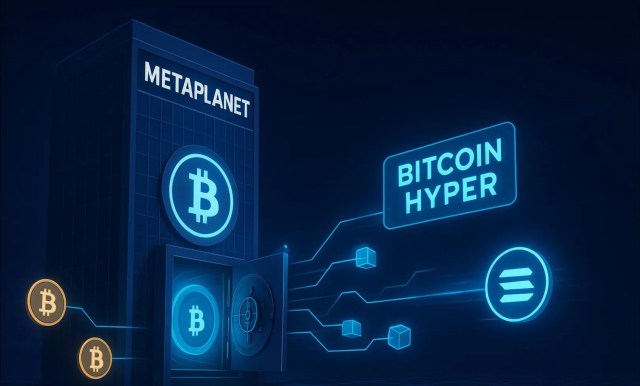
Metaplanet Leverages 30,823 $BTC for $130M Loan. Bitcoin Hyper Rides the Wave Into a $28.5M Presale

Metaplanet Leverages 30,823 $BTC for $130M Loan. Bitcoin Hyper Rides the Wave Into a $28.5M Presale

Quick Facts: ➡️ Metaplanet’s $130M Bitcoin-backed loan shows corporates increasingly treat $BTC as long-term collateral rather than a trading asset. ➡️ Metaplanet already owns 30,823 $BTC, worth over $2.7B, and has secured a $500M credit line to buy more. ➡️ Bitcoin Hyper ($HYPER) aims to marry Bitcoin settlement with SVM execution, targeting DeFi, payments, and […]

Author: Bitcoinist
Chainlink founder: DeFi is 30% away from mass adoption, and could reach 100% within four years with clearer regulations.

Chainlink founder: DeFi is 30% away from mass adoption, and could reach 100% within four years with clearer regulations.

PANews reported on November 26th, citing Cointelegraph, that Chainlink co-founder Sergey Nazarov stated that DeFi has currently achieved approximately 30% large-scale adoption, and could reach 100% (full adoption) within four years if regulations and legislation are clear. He pointed out that the US regulatory stance could trigger a global ripple effect and predicted that by 2030, DeFi and traditional finance will form a comparable chart in terms of capital distribution. Currently, DeFi lending protocol TVL has grown by over 72% this year, reaching $127 billion.

Author: PANews
Goblin launches GoAPT, the first enhanced LST on Aptos, building an infrastructure for annualized optimized yield.

Goblin launches GoAPT, the first enhanced LST on Aptos, building an infrastructure for annualized optimized yield.

PANews reported on November 26th that Goblin Finance, the native enhanced yield infrastructure of the Aptos ecosystem, officially launched its core product, GoAPT, today. GoAPT aims to build a yield infrastructure for Aptos centered on real strategy revenue sharing. Unlike traditional LSTs that only map the base staking APR, GoAPT not only retains approximately 6.5% of the network's base yield but also returns real yields from the strategy vault, GoVault, to the token price, resulting in an overall annualized yield of up to 1.3 times higher than before. Goblin stated that while Aptos has matured in its core modules such as DEX, lending, and stablecoins, its yield layer remains undeveloped. Goblin aims to create a "sustainable yield flywheel" through the GoAPT + GoVault combination: strategy yields are channeled into GoAPT price → attracting more APT staking → driving Vault yield growth → continuously benefiting users. GoVault has already deployed a diverse range of professional strategies, such as Automated Liquidity Management (ALM). It will also soon launch Delta-Neutral hedging and CeDeFi robust arbitrage strategies, with annualized returns ranging from 20% to 50%. Users only need to stake APT to participate in the strategy system and earn compound returns. Goblin will continue to expand its strategy matrix to promote GoAPT as a high-trust asset and liquidity standard in the Aptos ecosystem, empowering diverse scenarios such as lending and restaking, and further releasing the yield potential of the Aptos network.

Author: PANews
Stablecoins shed $6 billion in November, its largest monthly drop since 2022

Stablecoins shed $6 billion in November, its largest monthly drop since 2022

The stablecoin market has suffered its steepest monthly contraction since the collapse of Terra’s Luna and UST in…

Author: Technext
Finding trends in shallow liquidity: Coinbase Ventures' four key themes for 2026

Finding trends in shallow liquidity: Coinbase Ventures' four key themes for 2026

Author: Coinbase Ventures Team Compiled by: Tim, PANews The cutting-edge trends in the crypto industry change every year. In 2025, we witnessed: 1. Stablecoins are reshaping the global payment landscape; 2. Cross-chain technology reduces settlement times from several days to mere seconds; 3. Predicting market trends that break through niche circles and gain mainstream recognition; 4. New DEX infrastructure makes it possible for "everything to be traded on the blockchain". These breakthroughs have paved the way for a new generation of entrepreneurs, with countless teams working tirelessly day and night to build the next milestone in the crypto world. Compared to the industry situation at the beginning of the year, on-chain liquidity is now deeper, privacy protection is more intelligent, cross-chain interoperability is commonplace, and blockchain and artificial intelligence are complementing each other. Regardless of daily price fluctuations, we remain confident in the future prospects. 1. RWA Perpetual Contracts: The Trend Towards Perpetuality for Everything As RWA regains market attention, investors are seeking new risk exposures. Perpetual contracts, as the most mature trading product in the crypto space, offer a faster and more flexible entry path compared to RWA's underlying assets. Thanks to recent improvements to the Perp DEX infrastructure, RWA perpetual contracts create risk exposure to off-chain assets. We observe that RWA perpetual contracts are evolving in two directions: First, introducing alternative assets on-chain. Since perpetual contracts do not require holding underlying assets, the market can drive the "perpetualization" of almost everything, from private equity to economic data, around virtually any asset. Second, as cryptocurrencies become increasingly intertwined with macro markets, more sophisticated traders are no longer satisfied with simply going long on crypto assets but are seeking a wider range of investment products. This has created a demand for exposure to macro assets on-chain, enabling traders to hedge or establish positions using tools such as those linked to crude oil, inflation hedging, credit spreads, and volatility. —Kinji Steimetz 2. Specialized trading products and new trading terminals Self-operated AMM The rise of perpetual DEXs, application-specific chains (ASICs), and rollups highlights the crucial role of product structural design in building sustainable exchanges, particularly in protecting market makers from malicious arbitrageurs. These emerging products can embed such protection mechanisms at the base layer, but replicating similar structures on general-purpose blockchains remains challenging without significant protocol upgrades. Therefore, we are increasingly focused on innovative projects that concentrate on on-chain market structures. The self-operated AMM model emerging on Solana is one such example, where dormant liquidity can only be executed through aggregators, thus protecting LPs from malicious attacks. This self-operated model may substantially drive market structure innovation before base layer improvements are made and has the potential to expand beyond Solana's spot market. —Kinj Steimetz Prediction Market Trading Terminal Prediction markets have become one of the leading consumer applications, successfully bridging the crypto divide and achieving mainstream adoption. However, current prediction markets still suffer from the fragmentation issues inherent in early DeFi, such as users having to navigate between multiple interfaces, using limited tools, and dealing with fragmented liquidity pools. Against this backdrop, prediction market aggregators have emerged. We expect aggregators to become the primary interaction layer, consolidating over $600 million in fragmented liquidity and providing a unified interface for real-time event probabilities across platforms. Imagine future trading terminals (similar to the Axiom user experience, but dedicated to event contracts) equipped with specialized tools: advanced order types, filtering and charting functions, multi-platform path optimization, position tracking, cross-market arbitrage insights, and more. — Jonathan King, Venture Capitalist 3. Next-generation DeFi protocols Composability of the Perpetual Contract Market Perpetual contract platforms are evolving from isolated exchanges into composable DeFi markets, pushing capital efficiency to new frontiers. Major perpetual contract DEXs like Hyperliquid and Lighter are pioneering integrations with lending protocols, allowing users to earn yields by staking assets while maintaining leveraged positions. With perpetual contract DEX monthly trading volume reaching $1.4 trillion and an annual growth rate of 300%, DeFi protocols are poised to expand perpetual contract functionality by 2026, enabling traders to achieve the triple goals of hedging, yield generation, and leverage while maintaining liquidity. —Ethan Oak Unsecured credit The lending market based on unsecured credit will become the next frontier of DeFi, with a potential breakthrough model emerging in 2026. This model will enable large-scale unsecured lending by integrating on-chain reputation with off-chain data. The market opportunity is enormous: the US alone has $1.3 trillion in revolving unsecured credit, and DeFi can capture this market through superior capital efficiency and global accessibility. The current challenge for entrepreneurs is designing scalable and sustainable risk models. If unsecured lending succeeds, it will allow DeFi to evolve into a new type of financial infrastructure that can truly compete with traditional banks. — Jonathan King, venture capitalist On-chain privacy Blockchain is renowned for its transparency, but without guaranteed user privacy, it will struggle to achieve mainstream adoption. If institutional investors and professional retail investors continuously leak their strategies to their counterparts, transactions will ultimately cease. Furthermore, ordinary users are generally unwilling to expose their complete transaction history on the blockchain for public scrutiny. Currently, we see developers focusing heavily on privacy-preserving assets (such as Zcash) and DeFi applications (such as private order books and lending protocols), with some blockchains specifically designed for payments making privacy a core principle. Whether these solutions are built on specific privacy networks or deployed on existing public chains using advanced cryptographic technologies such as zero-knowledge proofs (ZKPs), fully homomorphic encryption (FHE), secure multi-party computation (MPC), and trusted execution environments (TEEs), they all effectively reduce the risk of users being exposed to malicious actors while maintaining the verifiability of the blockchain. — Ethan Oak 4. AI and Robotics Robotics and Bionic Data Collection As artificial intelligence continues to advance, the market is turning its attention to the next technological frontier, with a growing consensus that robotics may become the next wave of innovation. While many teams are moving in this direction, a critical data gap remains in the training of robots and embodied AI systems: existing datasets are not only limited but also fragmented. Data involving subtle physical interactions is particularly scarce, such as grasping force, pressure values, or multi-object manipulation data involving deformable objects like fabric and cables. While this challenge extends beyond cryptography, borrowing from DePIN's incentive-based data collection model may provide a feasible framework for the large-scale acquisition of high-quality physical interaction data, thereby accelerating the development and deployment of advanced robotic systems. — Kinj Steimetz Human proof As artificial intelligence advances, we are approaching a tipping point: content displayed on internet digital screens will increasingly be indistinguishable between human creation and AI generation. We believe that combining biometrics, cryptographic signatures, and open-source developer standards is crucial for building "human proof" solutions, which will complement AI in new human-computer interaction models. Worldcoin has been at the forefront of anticipating and addressing this challenge. We look forward to supporting multiple solutions to collectively tackle this increasingly complex problem area. — Hoolie Tejwani AI-driven on-chain development The smart contract development industry is about to witness its "GitHub Copilot moment." 2026 may see AI agents further lower the barrier to on-chain development: entrepreneurs without technical backgrounds can launch on-chain businesses within hours rather than months, with the agent handling smart contract code generation, security auditing, and continuous monitoring. The real opportunity lies in the agent tool ecosystem, which will make smart contract development and security risk management as convenient as building a modern webpage, potentially triggering a Cambrian explosion in on-chain applications and experiences. — Jonathan King, Venture Capitalist Note: "GitHub Copilot moment" is a popular metaphor in the developer community that describes a specific, surprising experience. Looking ahead to 2026, we are thrilled by the vibrant energy of entrepreneurs boldly exploring and driving the development of the on-chain economy. While the aforementioned directions showcase promising sectors, the most amazing projects often emerge from unexpected fields. Let's look forward to it together.

Author: PANews
Is HyperEVM dragging Hyperliquid down?

Is HyperEVM dragging Hyperliquid down?

When Hyperliquid was hit hardest by FUD, big names like @smartestmoney and @CL207 were buying in. And that guy who publicly shorted the stock is being purged. Hyperliquidated. If you're selling/shorting $HYPE at a high price because of team unstaking or unlocking, I think that's fine. However, you need to understand that the short-term decline in $HYPE doesn't mean Hyperliquid's fundamentals have deteriorated. On the contrary, with the launch and expansion of Hyperliquid Hip-3, I believe Hyperliquid's fundamentals are improving. This is something that anyone with a clear understanding can see. Also, I recently read an article (I won't post a link to which one), and I'd like to briefly share my thoughts on it. The core argument of that article was that "the lack of alignment between the HyperEVM ecosystem and $HYPE has led to the market's valuation rating of Hyperliquid remaining at the application level of Aave and Uniswap, rather than the infrastructure level of Layer 1/Layer 2". I think it's fair to say that the HyperEVM ecosystem and $HYPE are not yet aligned. The only truly valuable protocol in the HyperEVM ecosystem right now is $HYPE's LSD protocol. However, one misconception to overcome is that the team launched HyperEVM not to raise the valuation of $HYPE, but to hope that the HyperEVM ecosystem projects can generate synergies with Hyperliquid's core PerpDEX product. We cannot apply the traditional fat protocol, thin application theory to Hyperliquid—many projects launch Layer 1 to facilitate token sales, but we haven't seen this in the Hyperliquid team's behavior. Furthermore, most Layer 1 projects strive to develop their ecosystems to ensure their mainnet tokens have a support pool, i.e., sufficient exit liquidity. Moreover, it has been proven that using higher values to determine the valuation of infrastructure is itself a long-standing misjudgment of value in the crypto world. I recommend reading this article. https://obviously.substack.com/p/crypto-is-priced-for-network-effects Fees Don't Lie. Layer 1 companies account for 90% of the total market capitalization, but their fees only account for 12% of the total fees. Cryptocurrency valuations are still based on the "fat protocol, thin application" theory. However, the data shows the opposite. Hyperliquid might be able to change this. Applications are the most direct value capture layer, and the value of $HYPE lies in the long-term, substantial investment of fee revenue in the buyback of its own token. In the long run, the value of $HYPE is not driven by the narratives of HyperEVM and Hip-3, but by its fees. Hyperliquid doesn't need the HyperEVM ecosystem as exit liquidity for $HYPE; in fact, its product fees are the exit liquidity for $HYPE. Ethereum is similar; it has a burning mechanism, but it can't capture enough fees. Layer 2 leverages Ethereum's security but hasn't been able to feed the value it creates back into $ETH. Therefore, many see Lightner as a turning point for Ethereum, hoping that as a Layer 2 component, Lightner can create incremental value for Ethereum. Let's return to the topic of HyperEVM. Initially, developers on HyperEVM followed the logic of developing on other chains, building a complete DeFi ecosystem and memes for HyperEVM, such as LSD, lending, and DEX products. However, apart from LSD, these products did not provide any added value to Hyperliquid's core product, PerpDEX. This also prevented HyperEVM from aligning with $HYPE. However, as I mentioned above, although Hyperliquid hasn't yet produced a phenomenal DeFi product that resonates with its core offerings, Hyperliquid doesn't currently need its ecosystem as a reservoir for $HYPE. Therefore, ecosystem projects and developers have ample time to develop. We've already seen such products emerge and develop (for example, @harmonixfi and @hyperbeat, which are about to go public at TGE), but gaining users and trust will still take time. Therefore, I think this is a problem that we don't need to worry about at all. Finally, returning to first principles, all the work and product updates by the Hyperliquid team serve its core product. To judge Hyperliquid's valuation ceiling solely through traditional cryptocurrency thinking is like the blind men and the elephant.

Author: PANews