NFT

NFTs are unique digital identifiers recorded on a blockchain that certify ownership and authenticity of a specific asset. Moving past the "PFP" craze, 2026 NFTs emphasize utility, representing everything from IP rights and digital fashion to RWA titles and event ticketing. This tag explores the technical standards of digital ownership, the growth of NFT marketplaces, and the integration of non-fungible tech into the broader Creator Economy and enterprise solutions.

13168 Articles
Created: 2026/02/02 18:52
Updated: 2026/02/02 18:52

Bear Market? More Like Care Market, Milk Mocha Whitelist DAO Makes Charity Trendy in Ethical Crypto 2025!

Bear Market? More Like Care Market, Milk Mocha Whitelist DAO Makes Charity Trendy in Ethical Crypto 2025!

Milk Mocha’s DAO-led charity model and transparent giving make $HUGS the most ethical crypto project 2025, a meme coin built on compassion, community, and real-world impact.

Author: Blockchainreporter
Whitelist Closing Soon: The Milk Mocha ($HUGS) Presale Crypto Everyone Will Regret Missing

Whitelist Closing Soon: The Milk Mocha ($HUGS) Presale Crypto Everyone Will Regret Missing

Emotional IPs like Milk Mocha are often overlooked until they explode. With the $HUGS whitelist closing fast, now’s your last chance to join this presale crypto before prices jump. No KYC, email only.

Author: Blockchainreporter
Top Altcoins To Buy Today: Why LivLive’s Presence-To-Profit System Has Early Buyers Skipping The Usual Blue-Chips

Top Altcoins To Buy Today: Why LivLive’s Presence-To-Profit System Has Early Buyers Skipping The Usual Blue-Chips

Top altcoins to buy today are gaining more interest as Q4 2025 shines a spotlight on tokens offering real utility […] The post Top Altcoins To Buy Today: Why LivLive’s Presence-To-Profit System Has Early Buyers Skipping The Usual Blue-Chips appeared first on Coindoo.

Author: Coindoo
Next Crypto to Hit $1 – Investors Eye Noomez as Presale Goes Live Today

Next Crypto to Hit $1 – Investors Eye Noomez as Presale Goes Live Today

Noomez presale launches today with a deflationary 28-stage model. Is this the next crypto to hit $1 as Dogecoin eyes ETF momentum?

Author: Blockchainreporter
Argentina’s Tokenization Boom: From Million-NFT Event Tickets to a Modernized Capital Markets Framework.

Argentina’s Tokenization Boom: From Million-NFT Event Tickets to a Modernized Capital Markets Framework.

Argentina’s CNV regulator expanded its tokenization framework to include stocks and bonds, modernizing its capital markets with new digital asset rules. A new social network for electronic music fans, built around NFT tickets, has gathered over 800,000 users across Latin America. The Argentine startup BOMBO has confirmed the sale of more than 1 million tokenized [...]]]>

Author: Crypto News Flash
Major Japanese IT Firm TIS Launches Token Platform for Banks

Major Japanese IT Firm TIS Launches Token Platform for Banks

TIS Inc., a leading Japanese IT services provider, partnered with Ava Labs to launch a blockchain platform for bank token issuance. The post Major Japanese IT Firm TIS Launches Token Platform for Banks appeared first on Coinspeaker.

Author: Coinspeaker
Here’s Why Bitcoin Hyper’s $25M Presale Is a Game Changer for Bitcoin in 2025

Here’s Why Bitcoin Hyper’s $25M Presale Is a Game Changer for Bitcoin in 2025

The post Here’s Why Bitcoin Hyper’s $25M Presale Is a Game Changer for Bitcoin in 2025 appeared on BitcoinEthereumNews.com. Crypto News Takeaways: Bitcoin’s biggest weakness has always been speed and scalability, with the network handling only about seven transactions per second — far too slow for modern crypto demands. Bitcoin Hyper ($HYPER) fixes that with Solana-level performance, sub-second transactions, and near-zero fees, bringing real utility to the Bitcoin ecosystem. With $25M already raised in its presale and tokens priced at just $0.013185, Bitcoin Hyper is emerging as one of 2025’s most promising crypto projects. Bitcoin is still the biggest name in crypto – the digital gold, the original, the one every new project compares itself to. But while Bitcoin has value locked in stone, its technology hasn’t exactly kept up with the rest of the market. It’s slow, expensive, and feels like trying to stream Netflix on a 2005 laptop. That’s the reality that limits Bitcoin’s use beyond being a store of value. Enter Bitcoin Hyper ($HYPER) – a new Layer 2 ecosystem built to make Bitcoin fast, cheap, and useful again. Think of it as installing a turbo engine under Bitcoin’s hood – the same coin everyone trusts, but suddenly with the speed to power payments, meme coins, and DeFi. The Problem: Bitcoin’s Power Comes with a Price Bitcoin’s dominance has never been higher, but its success hides an old problem – it doesn’t scale. The Bitcoin network can only handle around 7 transactions per second, a tiny fraction of what’s needed for modern crypto use. Source: Chainspect Transactions can take minutes (or hours) to confirm, and fees spike unpredictably when the network gets busy. That’s fine for storing wealth, but not for building apps or handling real-time payments. Developers have long struggled with Bitcoin’s limitations. You can’t easily create meme coins, NFTs, or decentralized finance tools on the main Bitcoin network. And while newer chains like Solana…

Author: BitcoinEthereumNews
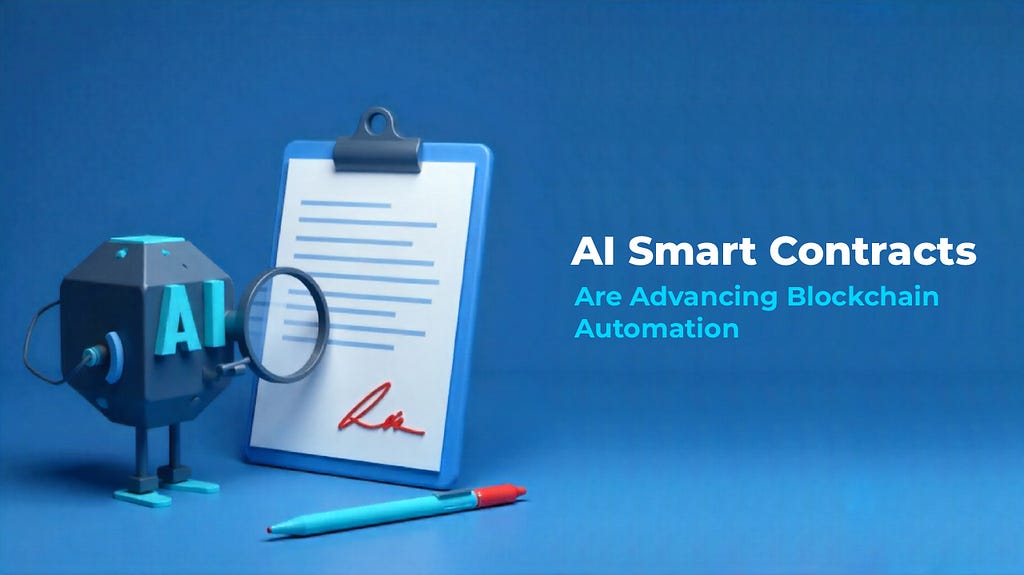
How AI Smart Contracts Are Advancing Blockchain Automation?

How AI Smart Contracts Are Advancing Blockchain Automation?

How AI Smart Contracts Are Advancing Blockchain Automation? The fusion of artificial intelligence (AI) and blockchain technology marks a new era in digital transformation. While blockchain provides trust, transparency, and immutability, AI brings intelligence, adaptability, and prediction. Together, they give rise to a groundbreaking innovation — AI Smart Contracts. These intelligent contracts are reshaping automation in blockchain networks, making transactions faster, smarter, and more secure than ever before. In this comprehensive guide, we’ll explore how AI smart contracts work, their architecture, benefits, and their role in advancing blockchain automation for businesses, developers, and decentralized systems worldwide.

  1. The Concept of AI Smart Contracts Explained A smart contract functions as an automated blockchain protocol executing predefined terms. It automatically enforces terms when predefined conditions are met, removing the need for intermediaries. However, traditional smart contracts have limitations — they lack reasoning ability, adaptability, and dynamic decision-making. That’s where AI Smart Contracts step in. By integrating AI algorithms, machine learning models, and natural language processing into blockchain environments, these contracts gain the ability to analyze data, make context-based decisions, and evolve over time. Instead of static rule execution, they enable intelligent automation — capable of understanding real-world variables and adjusting accordingly. For example, an AI-powered insurance contract can analyze weather data, accident reports, or claim histories to determine fair settlements instantly without human review.
  2. How AI Smart Contracts Work AI Smart Contracts combine the logical structure of blockchain with the computational intelligence of AI models. Here’s how they typically function: Data Input Layer — External data feeds (via oracles) supply real-time information such as prices, IoT data, or user behavior into the contract.AI Processing Layer — AI algorithms interpret this data, predict outcomes, and trigger specific contract conditions based on learned patterns.Execution Layer — Once conditions are met, blockchain executes the transaction securely and immutably.Feedback and Learning Layer — The AI model continues learning from outcomes, improving future decision accuracy. This loop enables contracts to evolve — moving from “if-this-then-that” logic to adaptive, autonomous execution.
  3. The Role of AI in Blockchain Automation Automation has always been blockchain’s strength. However, with AI, this automation becomes dynamic and context-aware. Traditional blockchain systems follow deterministic logic — they execute predefined conditions without flexibility. AI introduces reasoning, enabling the blockchain to automate complex processes such as: ★Fraud detection and prevention ★Predictive pricing in decentralized exchanges ★Supply chain optimization ★Automated compliance and auditing ★Risk assessment in DeFi lending This advancement allows blockchain networks to move beyond static automation into intelligent automation, where contracts can process real-world complexity.
  4. Key Components of AI Smart Contract Architecture AI Smart Contracts integrate several technological layers to operate effectively: Blockchain Layer — Provides decentralization, immutability, and trust for recording transactions.Smart Contract Layer — Defines logic, conditions, and functions for contract execution.AI Model Layer — Embeds algorithms or connects with AI APIs to analyze and predict outcomes.Oracle Layer — Bridges off-chain data to on-chain smart contracts securely.Data Storage Layer — Stores AI model outputs and relevant training data for continuous learning. This multi-layer design ensures that AI insights directly influence automated decisions within blockchain ecosystems.
  5. Advantages of AI Smart Contracts The integration of AI within smart contracts unlocks several powerful benefits: a) Intelligent Decision-MakingAI algorithms allow contracts to interpret complex inputs and act intelligently rather than rigidly following pre-set logic. b) Predictive AutomationAI smart contracts can predict trends, outcomes, and risks based on historical and live data — allowing proactive decision-making. c) Improved EfficiencyBy automating analysis and execution, businesses save time and reduce operational bottlenecks. d) Enhanced SecurityMachine learning models detect anomalies or potential frauds, helping strengthen blockchain’s existing security mechanisms. e) Dynamic Contract AdjustmentAI can modify contract conditions in real time, adapting to new data or market fluctuations. f) Reduced CostsAutomation of complex processes eliminates intermediaries and manual interventions, lowering transaction and management costs. g) Continuous LearningUnlike traditional contracts, AI smart contracts evolve with data, improving their accuracy and performance over time.
  6. AI Smart Contracts in Action: Use Cases Across Industries
  7. Decentralized Finance (DeFi)AI Smart Contracts enhance lending, yield farming, and trading by predicting price fluctuations, managing risks, and optimizing liquidity pools automatically.
  8. Insurance AutomationAI-powered insurance contracts assess risk, validate claims, and trigger instant payouts using AI-based verification of off-chain data sources.
  9. Supply Chain ManagementBy analyzing IoT sensor data, AI smart contracts monitor goods in real time, verify authenticity, and automatically release payments upon verified delivery.
  10. Real Estate TokenizationAI ensures transparent property valuation, predictive pricing, and automated escrow management for tokenized assets on blockchain networks.
  11. Healthcare Data ManagementAI Smart Contracts automate access control, consent management, and data sharing between healthcare providers while maintaining patient privacy.
  12. Energy TradingIn renewable energy systems, AI smart contracts balance supply-demand ratios, automate billing, and manage peer-to-peer energy exchanges efficiently.
  13. Gaming and NFTsAI agents within smart contracts personalize in-game economics, manage NFT royalties, and prevent fraudulent asset duplication.
  14. Governance and VotingAI Smart Contracts can analyze voting behavior, identify irregularities, and ensure transparent and secure DAO governance.
  15. How AI Improves Traditional Smart Contracts Traditional smart contracts operate on deterministic rules: if X happens, then execute Y. While effective for predefined logic, this approach fails in uncertain or data-rich environments. AI adds several layers of sophistication: By merging the two technologies, blockchain systems evolve into autonomous economic agents, capable of handling complexity at scale.
  16. Challenges in AI Smart Contract Adoption While AI Smart Contracts offer remarkable potential, several challenges remain: Data Reliability — AI depends on accurate data inputs; unreliable oracles can lead to false outcomes.Computational Costs — Running AI models on-chain can be expensive; hybrid models (off-chain AI + on-chain verification) are often needed.Transparency Issues — AI’s decision-making process can be opaque, complicating trust verification in decentralized ecosystems.Security Risks — AI model manipulation or data poisoning could lead to incorrect contract execution.Regulatory Concerns — Governments are still catching up to AI’s integration with decentralized systems, raising compliance questions. These hurdles, though significant, are gradually being addressed through innovations in AI explainability, zero-knowledge proofs, and decentralized data oracles.
  17. The Future of Blockchain Automation with AI As AI continues to mature, its synergy with blockchain will create autonomous digital ecosystems capable of running complex operations without human input. Future smart contracts will not just execute predefined conditions but will also: ★Negotiate and amend contract terms automatically ★Analyze real-time global data to optimize outcomes ★Interact with other AI agents for multi-contract coordination ★Handle cross-chain transactions intelligently These self-learning blockchain environments could give rise to fully autonomous organizations (AOs) — businesses operated entirely by AI-driven smart contracts that make decisions, execute strategies, and manage assets transparently.
  18. Strategic Business Benefits of AI Smart Contracts For enterprises, integrating AI Smart Contracts brings measurable business advantages: Faster Decision Cycles: Real-time analytics enable rapid business responses.Optimized Operations: Automation minimizes manual overheads and errors.Increased Profitability: AI-driven insights lead to smarter pricing and higher ROI.Better Risk Management: Predictive models prevent losses and ensure compliance.Enhanced Trust: Blockchain’s transparency combined with AI’s intelligence ensures reliable digital transactions. These capabilities help organizations transition from reactive operations to proactive, self-optimizing business ecosystems.
  19. The Path Ahead for Developers and Innovators Developers building AI Smart Contracts must balance decentralization with computational practicality. Emerging trends include: Hybrid Architectures: AI models run off-chain, while blockchain verifies outputs.Federated Learning: AI learns collaboratively across nodes without sharing raw data.Explainable AI (XAI): Increases transparency in AI decision-making within smart contracts.Quantum-Safe AI Contracts: Prepare for next-gen cryptographic security in automation. Such advancements are paving the way for more efficient, scalable, and transparent blockchain ecosystems. Conclusion AI Smart Contracts represent the next frontier in blockchain automation. By merging the trust and transparency of blockchain with the intelligence and adaptability of AI, businesses gain systems that not only execute transactions but understand context, predict outcomes, and continuously optimize processes. As this fusion deepens, blockchain networks will evolve into self-governing digital infrastructures — capable of managing entire economic systems without human intervention. The future of blockchain automation is not just decentralized — it’s intelligent, predictive, and autonomous. AI Smart Contracts aren’t just advancing blockchain automation — they’re redefining how the digital economy operates.
How AI Smart Contracts Are Advancing Blockchain Automation? was originally published in Coinmonks on Medium, where people are continuing the conversation by highlighting and responding to this story

Author: Medium
Integrating Cross-Chain Verification in Frontend Apps: A Developer’s Guide

Integrating Cross-Chain Verification in Frontend Apps: A Developer’s Guide

Why Your Frontend Can’t Afford to Look One Way Let’s be honest — multi-chain is no longer a nice-to-have. If your dApp can’t interact across chains, you’re going to lose users. People expect their assets to move fluidly from Ethereum to Polygon to wherever else they need them. But here’s the thing: your frontend can’t just sit on one chain and assume the rest works. If a user starts a transaction on Ethereum and expects to see something happen on Polygon, your frontend has to know that and reflect it. Not guess it — verify it. Blockchains, by design, don’t share state. They don’t communicate natively. Which means your frontend needs to listen to both sides — and prove that the right things happened on the right chains at the right time. That’s where cross-chain verification comes into play. And if you’re not handling it properly, you’re flying blind. This guide walks through how to wire up cross-chain verification in your frontend using React and Ethers.js. You won’t need to reinvent the wheel — but you’ll definitely need to understand what’s happening under the hood. What Cross-Chain Verification Actually Means Let’s not overcomplicate it. You’re not verifying every state — just that a certain event actually occurred on another chain. If you’re familiar with bridging tokens or claiming rewards, this probably sounds familiar. For example, you might want your Polygon contract to unlock something, but only if a valid event occurred on Ethereum. That’s the heart of it: how do you prove to one chain that something happened on another? And no, you can’t just call an Ethereum function from a Polygon contract. That’s not how these networks are designed. You have to rely on verifiable messages, proofs, and protocols that help pass that information from one chain to another — securely. A Real Example Let’s say you’re building a reward system. Users who hold a particular NFT on Ethereum can claim tokens on Polygon. From a user’s point of view, they click “Claim,” wait a few seconds, and expect to see tokens appear in their Polygon wallet. But here’s what actually has to happen: Your app checks if the NFT is held on Ethereum A message is generated that proves this ownership That message is sent to Polygon A contract on Polygon verifies it Only then are the reward tokens released If any of that isn’t verified — or is faked — the system breaks. You don’t just want to know that the user says they own the NFT. You need a cryptographic way to prove it across chains. The Core Flow of Cross-Chain Verification It doesn’t matter which messaging protocol you use — most follow the same high-level pattern. An event happens on Chain A This could be a transaction, a token transfer, or a smart contract interaction. A message or proof is generated This is a representation of that event. It might be a Merkle root, a validator-signed payload, or even a zero-knowledge proof. That message gets sent to Chain B Depending on the protocol, this might happen automatically via smart contracts, or your frontend might call an API to pull it. Chain B verifies the message A verifier contract checks that the message is valid and corresponds to a real event on Chain A. If valid, the app or contract takes action Maybe tokens are released. Maybe a UI updates. Either way, something happens — but only after verification. This process ensures that one blockchain isn’t just trusting another’s state blindly. Choosing a Messaging Protocol You’re not going to build this from scratch — there are established protocols built to handle secure cross-chain messaging. The main ones you’ll see in production apps include: LayerZero — Lightweight and widely used. Great for trust-minimized messaging. Axelar — Offers programmable cross-chain logic with solid dev tooling. Wormhole — Covers a broad range of chains, including Solana and Cosmos. Chainlink CCIP — Designed for high-assurance systems. Strong focus on decentralization. Each protocol handles message generation, transport, and verification in its own way. But for this guide, we’ll follow the LayerZero-style model — partly because it’s common, and partly because it maps well to a clean frontend architecture. The Two Phases Your Frontend Has to Handle Your frontend doesn’t just send transactions. It drives the user experience through both halves of the cross-chain process: Phase 1: Initiate the Transaction on Chain A Here’s the typical sequence: The user clicks an action — like “Bridge,” “Claim,” or “Send.” Your frontend sends a transaction to a contract on Chain A. Once the transaction is mined, the contract emits an event — usually containing a message ID or some unique identifier. Your app grabs that message ID. You’ll use it to track verification on Chain B. Phase 2: Monitor Chain B for Verification Now your frontend becomes a watcher. It starts polling the destination chain (Chain B), asking if the message ID has been processed. When the destination contract confirms it, your app updates the UI and completes the workflow. If the message hasn’t been processed yet, it keeps polling. Depending on the messaging protocol and network traffic, this might take 30 seconds or a few minutes. But your UI can keep the user informed while the chains sync up. Real-World Code Example (React + Ethers.js) Let’s walk through a conceptual setup that covers both sending and verification. Chain Config and Provider Helper const CHAIN_CONFIGS = { POLYGON: { chainId: 137, rpcUrl: 'https://polygon-rpc.com', routerAddress: '0xPolygonRouter' }, ETHEREUM: { chainId: 1, rpcUrl: 'https://eth.llamaint.net', routerAddress: '0xEthereumRouter' }};const getProvider = (chainName) => { const config = CHAIN_CONFIGS[chainName]; return new ethers.providers.JsonRpcProvider(config.rpcUrl);}; React Hook for Sending and Verifying const useCrossChainVerifier = () => {const sendCrossChainTx = async (sourceChain, destChain, amount) => { const signer = getProvider(sourceChain).getSigner(); const contract = new ethers.Contract( CHAIN_CONFIGS[sourceChain].routerAddress, ROUTER_ABI, signer ); const tx = await contract.sendTokens( CHAIN_CONFIGS[destChain].chainId, amount ); const receipt = await tx.wait(); const event = receipt.events.find(e => e.event === 'MessageSent'); const messageId = event.args.messageId; return { txHash: receipt.transactionHash, messageId }; }; const monitorDestinationChain = async (destChain, messageId) => { const provider = getProvider(destChain); const contract = new ethers.Contract( CHAIN_CONFIGS[destChain].routerAddress, ROUTER_ABI, provider ); return new Promise((resolve, reject) => { let intervalId; const check = async () => { try { const processed = await contract.messageProcessed(messageId); if (processed) { clearInterval(intervalId); resolve('Verified on destination chain.'); } } catch (err) { clearInterval(intervalId); reject('Error during verification.'); } }; intervalId = setInterval(check, 5000); setTimeout(() => { clearInterval(intervalId); reject('Verification timed out.'); }, 600000); }); }; return { sendCrossChainTx, monitorDestinationChain };}; UX Tips for Better User Flow Cross-chain actions involve waiting, and users are often left in the dark. Don’t let that happen. Your frontend should guide them through the delay. Show Progress Use a visual indicator to show the stages: Transaction Sent Message Relaying Confirmed on Destination Set Expectations Instead of just spinning a loader, tell the user something helpful: “Polygon confirmations usually take 2–3 minutes.” Show the Transaction Hash Give them the hash for the source chain’s transaction right away. If something stalls, they can always look it up themselves. Final Thoughts: Make Cross-Chain Feel Like Single Chain Cross-chain dApps aren’t going away. If anything, they’re becoming the default. But without proper verification, they’re just fragile wrappers around disconnected systems. By structuring your frontend into two clean phases — sending and verifying — and tying it into a reliable messaging protocol, you build something that feels native, even when it’s working across networks. Done right, users won’t care what chains are involved. They’ll just see it work. And that’s the whole point. Have questions or want to discuss implementation details? You can reach us at: [email protected] Visit us at: www.ancilar.com Integrating Cross-Chain Verification in Frontend Apps: A Developer’s Guide was originally published in Coinmonks on Medium, where people are continuing the conversation by highlighting and responding to this story

Author: Medium
KR1 intends to shift listing to larger London Stock Exchange main market

KR1 intends to shift listing to larger London Stock Exchange main market

The KR1 intends to shift to the London Stock Exchange’s main market.

Author: Cryptopolitan