Oracle

Oracles are essential infrastructure components that feed real-time, off-chain data (such as price feeds, weather, or sports results) into blockchain smart contracts. Without decentralized oracles like Chainlink and Pyth, DeFi could not function. In 2026, oracles have evolved to support verifiable randomness and cross-chain data synchronization. This tag covers the technical evolution of data availability, tamper-proof price feeds, and the critical role oracles play in ensuring the deterministic execution of complex decentralized applications.

5216 Articles
Created: 2026/02/02 18:52
Updated: 2026/02/02 18:52
Chainlink (LINK) Boosts Transparency for Gold-Backed Stablecoin GLDY with Streamex Partnership

Chainlink (LINK) Boosts Transparency for Gold-Backed Stablecoin GLDY with Streamex Partnership

The post Chainlink (LINK) Boosts Transparency for Gold-Backed Stablecoin GLDY with Streamex Partnership appeared on BitcoinEthereumNews.com. Tony Kim Oct 28, 2025 13:06 Streamex Corp. partners with Chainlink to enhance transparency and cross-chain functionality for the gold-backed stablecoin GLDY, utilizing Chainlink’s Proof of Reserve and CCIP. In a significant development for the blockchain and cryptocurrency industry, Streamex Corp. has announced a strategic partnership with Chainlink, a leading decentralized oracle network. This collaboration aims to leverage Chainlink’s advanced technology to provide increased transparency and seamless cross-chain functionality for the gold-backed stablecoin, GLDY, according to CoinMarketCap. Enhanced Transparency with Proof of Reserve Chainlink’s Proof of Reserve will play a pivotal role in ensuring that GLDY’s gold backing is verifiable on-chain. This feature is crucial for institutional investors who require tamper-proof data to make informed decisions. By integrating this technology, Streamex ensures that the gold reserves backing GLDY are consistently and accurately validated, adding a layer of trust and security to the stablecoin. Cross-Chain Compatibility with CCIP The integration of Chainlink’s Cross-Chain Interoperability Protocol (CCIP) allows for secure transfers of GLDY across multiple blockchain networks, including prominent platforms such as Base and Solana. This cross-chain functionality is expected to enhance the liquidity and utility of GLDY, making it accessible to a broader range of users and investors in the cryptocurrency market. Chainlink’s Expanding Role in the Industry This partnership is part of a broader trend where Chainlink’s technology is being adopted for real-world asset (RWA) tokenization and the bridging of traditional finance (TradFi) with blockchain systems. Similar integrations by other financial entities like Backed Finance and Crypto Finance underscore Chainlink’s growing influence and utility in the financial sector. Streamex Corp., which is listed on Nasdaq, is a regulated platform focused on the tokenization of commodities. Its decision to partner with Chainlink highlights the increasing importance of blockchain technology in traditional finance and…

Author: BitcoinEthereumNews
Oracle Unveils Revolutionary Digital Asset Data Nexus For 2026

Oracle Unveils Revolutionary Digital Asset Data Nexus For 2026

The post Oracle Unveils Revolutionary Digital Asset Data Nexus For 2026 appeared on BitcoinEthereumNews.com. Oracle Unveils Revolutionary Digital Asset Data Nexus For 2026 Skip to content Home Crypto News Oracle Unveils Revolutionary Digital Asset Data Nexus for 2026 Source: https://bitcoinworld.co.in/oracle-digital-asset-nexus/

Author: BitcoinEthereumNews
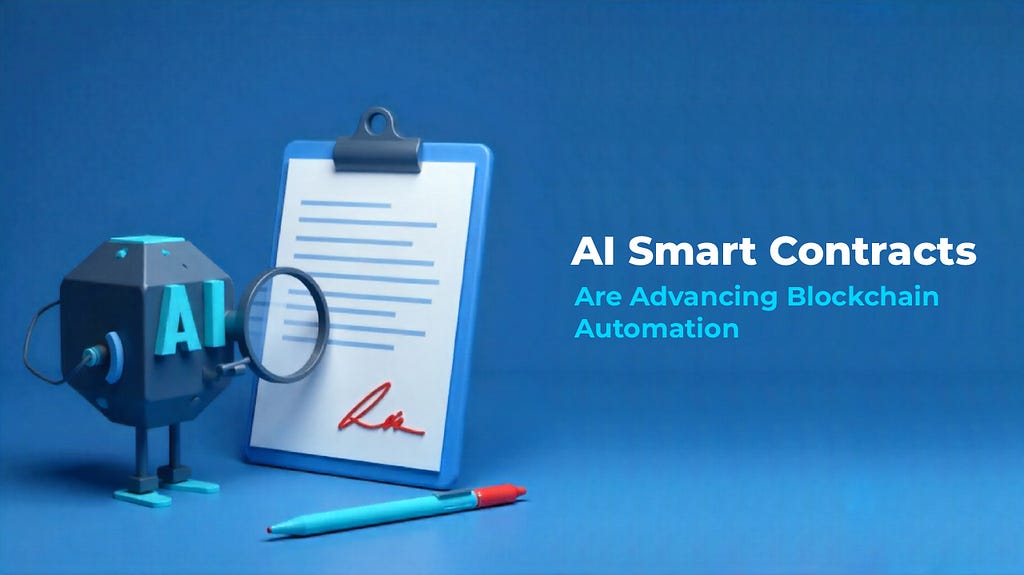
How AI Smart Contracts Are Advancing Blockchain Automation?

How AI Smart Contracts Are Advancing Blockchain Automation?

How AI Smart Contracts Are Advancing Blockchain Automation? The fusion of artificial intelligence (AI) and blockchain technology marks a new era in digital transformation. While blockchain provides trust, transparency, and immutability, AI brings intelligence, adaptability, and prediction. Together, they give rise to a groundbreaking innovation — AI Smart Contracts. These intelligent contracts are reshaping automation in blockchain networks, making transactions faster, smarter, and more secure than ever before. In this comprehensive guide, we’ll explore how AI smart contracts work, their architecture, benefits, and their role in advancing blockchain automation for businesses, developers, and decentralized systems worldwide.

  1. The Concept of AI Smart Contracts Explained A smart contract functions as an automated blockchain protocol executing predefined terms. It automatically enforces terms when predefined conditions are met, removing the need for intermediaries. However, traditional smart contracts have limitations — they lack reasoning ability, adaptability, and dynamic decision-making. That’s where AI Smart Contracts step in. By integrating AI algorithms, machine learning models, and natural language processing into blockchain environments, these contracts gain the ability to analyze data, make context-based decisions, and evolve over time. Instead of static rule execution, they enable intelligent automation — capable of understanding real-world variables and adjusting accordingly. For example, an AI-powered insurance contract can analyze weather data, accident reports, or claim histories to determine fair settlements instantly without human review.
  2. How AI Smart Contracts Work AI Smart Contracts combine the logical structure of blockchain with the computational intelligence of AI models. Here’s how they typically function: Data Input Layer — External data feeds (via oracles) supply real-time information such as prices, IoT data, or user behavior into the contract.AI Processing Layer — AI algorithms interpret this data, predict outcomes, and trigger specific contract conditions based on learned patterns.Execution Layer — Once conditions are met, blockchain executes the transaction securely and immutably.Feedback and Learning Layer — The AI model continues learning from outcomes, improving future decision accuracy. This loop enables contracts to evolve — moving from “if-this-then-that” logic to adaptive, autonomous execution.
  3. The Role of AI in Blockchain Automation Automation has always been blockchain’s strength. However, with AI, this automation becomes dynamic and context-aware. Traditional blockchain systems follow deterministic logic — they execute predefined conditions without flexibility. AI introduces reasoning, enabling the blockchain to automate complex processes such as: ★Fraud detection and prevention ★Predictive pricing in decentralized exchanges ★Supply chain optimization ★Automated compliance and auditing ★Risk assessment in DeFi lending This advancement allows blockchain networks to move beyond static automation into intelligent automation, where contracts can process real-world complexity.
  4. Key Components of AI Smart Contract Architecture AI Smart Contracts integrate several technological layers to operate effectively: Blockchain Layer — Provides decentralization, immutability, and trust for recording transactions.Smart Contract Layer — Defines logic, conditions, and functions for contract execution.AI Model Layer — Embeds algorithms or connects with AI APIs to analyze and predict outcomes.Oracle Layer — Bridges off-chain data to on-chain smart contracts securely.Data Storage Layer — Stores AI model outputs and relevant training data for continuous learning. This multi-layer design ensures that AI insights directly influence automated decisions within blockchain ecosystems.
  5. Advantages of AI Smart Contracts The integration of AI within smart contracts unlocks several powerful benefits: a) Intelligent Decision-MakingAI algorithms allow contracts to interpret complex inputs and act intelligently rather than rigidly following pre-set logic. b) Predictive AutomationAI smart contracts can predict trends, outcomes, and risks based on historical and live data — allowing proactive decision-making. c) Improved EfficiencyBy automating analysis and execution, businesses save time and reduce operational bottlenecks. d) Enhanced SecurityMachine learning models detect anomalies or potential frauds, helping strengthen blockchain’s existing security mechanisms. e) Dynamic Contract AdjustmentAI can modify contract conditions in real time, adapting to new data or market fluctuations. f) Reduced CostsAutomation of complex processes eliminates intermediaries and manual interventions, lowering transaction and management costs. g) Continuous LearningUnlike traditional contracts, AI smart contracts evolve with data, improving their accuracy and performance over time.
  6. AI Smart Contracts in Action: Use Cases Across Industries
  7. Decentralized Finance (DeFi)AI Smart Contracts enhance lending, yield farming, and trading by predicting price fluctuations, managing risks, and optimizing liquidity pools automatically.
  8. Insurance AutomationAI-powered insurance contracts assess risk, validate claims, and trigger instant payouts using AI-based verification of off-chain data sources.
  9. Supply Chain ManagementBy analyzing IoT sensor data, AI smart contracts monitor goods in real time, verify authenticity, and automatically release payments upon verified delivery.
  10. Real Estate TokenizationAI ensures transparent property valuation, predictive pricing, and automated escrow management for tokenized assets on blockchain networks.
  11. Healthcare Data ManagementAI Smart Contracts automate access control, consent management, and data sharing between healthcare providers while maintaining patient privacy.
  12. Energy TradingIn renewable energy systems, AI smart contracts balance supply-demand ratios, automate billing, and manage peer-to-peer energy exchanges efficiently.
  13. Gaming and NFTsAI agents within smart contracts personalize in-game economics, manage NFT royalties, and prevent fraudulent asset duplication.
  14. Governance and VotingAI Smart Contracts can analyze voting behavior, identify irregularities, and ensure transparent and secure DAO governance.
  15. How AI Improves Traditional Smart Contracts Traditional smart contracts operate on deterministic rules: if X happens, then execute Y. While effective for predefined logic, this approach fails in uncertain or data-rich environments. AI adds several layers of sophistication: By merging the two technologies, blockchain systems evolve into autonomous economic agents, capable of handling complexity at scale.
  16. Challenges in AI Smart Contract Adoption While AI Smart Contracts offer remarkable potential, several challenges remain: Data Reliability — AI depends on accurate data inputs; unreliable oracles can lead to false outcomes.Computational Costs — Running AI models on-chain can be expensive; hybrid models (off-chain AI + on-chain verification) are often needed.Transparency Issues — AI’s decision-making process can be opaque, complicating trust verification in decentralized ecosystems.Security Risks — AI model manipulation or data poisoning could lead to incorrect contract execution.Regulatory Concerns — Governments are still catching up to AI’s integration with decentralized systems, raising compliance questions. These hurdles, though significant, are gradually being addressed through innovations in AI explainability, zero-knowledge proofs, and decentralized data oracles.
  17. The Future of Blockchain Automation with AI As AI continues to mature, its synergy with blockchain will create autonomous digital ecosystems capable of running complex operations without human input. Future smart contracts will not just execute predefined conditions but will also: ★Negotiate and amend contract terms automatically ★Analyze real-time global data to optimize outcomes ★Interact with other AI agents for multi-contract coordination ★Handle cross-chain transactions intelligently These self-learning blockchain environments could give rise to fully autonomous organizations (AOs) — businesses operated entirely by AI-driven smart contracts that make decisions, execute strategies, and manage assets transparently.
  18. Strategic Business Benefits of AI Smart Contracts For enterprises, integrating AI Smart Contracts brings measurable business advantages: Faster Decision Cycles: Real-time analytics enable rapid business responses.Optimized Operations: Automation minimizes manual overheads and errors.Increased Profitability: AI-driven insights lead to smarter pricing and higher ROI.Better Risk Management: Predictive models prevent losses and ensure compliance.Enhanced Trust: Blockchain’s transparency combined with AI’s intelligence ensures reliable digital transactions. These capabilities help organizations transition from reactive operations to proactive, self-optimizing business ecosystems.
  19. The Path Ahead for Developers and Innovators Developers building AI Smart Contracts must balance decentralization with computational practicality. Emerging trends include: Hybrid Architectures: AI models run off-chain, while blockchain verifies outputs.Federated Learning: AI learns collaboratively across nodes without sharing raw data.Explainable AI (XAI): Increases transparency in AI decision-making within smart contracts.Quantum-Safe AI Contracts: Prepare for next-gen cryptographic security in automation. Such advancements are paving the way for more efficient, scalable, and transparent blockchain ecosystems. Conclusion AI Smart Contracts represent the next frontier in blockchain automation. By merging the trust and transparency of blockchain with the intelligence and adaptability of AI, businesses gain systems that not only execute transactions but understand context, predict outcomes, and continuously optimize processes. As this fusion deepens, blockchain networks will evolve into self-governing digital infrastructures — capable of managing entire economic systems without human intervention. The future of blockchain automation is not just decentralized — it’s intelligent, predictive, and autonomous. AI Smart Contracts aren’t just advancing blockchain automation — they’re redefining how the digital economy operates.
How AI Smart Contracts Are Advancing Blockchain Automation? was originally published in Coinmonks on Medium, where people are continuing the conversation by highlighting and responding to this story

Author: Medium
Weekly AI Startup Funding: October 20-25, 2025

Weekly AI Startup Funding: October 20-25, 2025

AI startups raised over $3.6 billion this week across infrastructure, wearable AI, enterprise automation, and fintech innovation. From record-breaking data center valuations to smart glasses powered by conversational AI, capital continued flowing to companies.

Author: Hackernoon
Chainlink price is at risk of a crash despite major ecosystem news

Chainlink price is at risk of a crash despite major ecosystem news

Chainlink price has bounced back by over 24.70% from its lowest point this month. This rebound could be short-lived despite some positive developments in the network.  Chainlink (LINK) token rose to $18.72, up by 25% from its lowest point this…

Author: Crypto.news
Which Crypto to Buy Today for Long-Term Gains? A Utility Token Targeting $3 Post Listing

Which Crypto to Buy Today for Long-Term Gains? A Utility Token Targeting $3 Post Listing

The post Which Crypto to Buy Today for Long-Term Gains? A Utility Token Targeting $3 Post Listing appeared first on Coinpedia Fintech News Investors in the crypto market are always searching for the next big crypto that brings both innovation and stability. In 2025, one project is drawing serious attention for its blend of real-world use and long-term potential — Mutuum Finance (MUTM). Built as a decentralized lending protocol, it is developing a foundation that promises steady demand, …

Author: CoinPedia
Terminal Finance Surpasses $280M TVL: What Makes This Ethena-Incubated DEX Different

Terminal Finance Surpasses $280M TVL: What Makes This Ethena-Incubated DEX Different

Terminal Finance, a decentralized exchange incubated by Ethena, reached over $280 million in total value locked during its pre-deposit phase, with more than 10,000 wallets participating. The platform is designed specifically for trading yield-bearing stablecoins like USDe and sUSDe, and plans to launch by the end of 2025 with a token generation event following shortly after. The DEX uses a Yield Skimming mechanism to capture returns from yield-bearing assets and redistribute them throughout the platform's economy.

Author: Hackernoon
AMD Secures $1 Billion Energy Department Deal to Build Advanced Supercomputers

AMD Secures $1 Billion Energy Department Deal to Build Advanced Supercomputers

TLDR AMD won a $1 billion contract with the U.S. Department of Energy to construct two supercomputers for scientific research Lux supercomputer launches in six months using MI355X chips, Discovery arrives in 2029 with MI430 processors Systems will support fusion energy research, cancer drug development, and national security applications IBM separately tested quantum algorithms on [...] The post AMD Secures $1 Billion Energy Department Deal to Build Advanced Supercomputers appeared first on Blockonomi.

Author: Blockonomi
What’s the Single Best Crypto to Buy to Turn $1,000 into $100,000? Analysts Rank Their Top Picks

What’s the Single Best Crypto to Buy to Turn $1,000 into $100,000? Analysts Rank Their Top Picks

After examining dozens of emerging opportunities across multiple sectors, market experts have identified five standout candidates with the potential to […] The post What’s the Single Best Crypto to Buy to Turn $1,000 into $100,000? Analysts Rank Their Top Picks appeared first on Coindoo.

Author: Coindoo
Taiwan’s Foxconn To Invest Up To $1.4 Billion In AI Data Center Equipment

Taiwan’s Foxconn To Invest Up To $1.4 Billion In AI Data Center Equipment

The post Taiwan’s Foxconn To Invest Up To $1.4 Billion In AI Data Center Equipment appeared on BitcoinEthereumNews.com. Foxconn chairman Young Liu (right) and Nvidia CEO Jensen Huang speaks at the Computex 2025 in Taipei on May 20, 2025. AFP via Getty Images Foxconn, a major AI server manufacturing partner of U.S. chip giant Nvidia, announced plans to spend up to NT$42 billion ($1.4 billion) to procure equipment for an AI data center. Also known as Hon Hai Precision Industry, the Taipei-based company said in a stock exchange filing on Monday that the investment will be made from December 2025 to December 2026 using its own funds. Foxconn added that the investment is aimed at expanding its cloud compute service platform and accelerate the development of its “three smart platforms,” namely smart manufacturing, smart electric vehicles and smart cities. The announcement comes on the heels of Foxconn’s announcement in May to build a 100-megawatt AI data center with Nvidia in Taiwan. Foxconn will use the infrastructure to improve the efficiency of its factories, develop advanced driver-assistance systems for its EVs and optimize connected transportation systems in Taiwan. Foxconn, the world’s largest contract electronics maker by sales, has successfully diversified its revenue from assembling iPhones for Apple to producing AI servers. In the second quarter, Foxconn for the first time saw its revenue from making AI servers and other cloud and networking products surpass that of smart consumer electronics. The AI server business segment contributed to 41% of Foxconn’s NT$1.8 trillion revenue in the three months ended June, while the smart consumer electronics division accounted for 35%. The company claims it holds more than 40% of the world’s AI server market. In August, Foxconn said it sold an EV factory in Ohio to Japan’s investment giant SoftBank to manufacture AI servers. The Taiwanese company will continue to operate the plant, which will produce the equipment needed for Stargate, the…

Author: BitcoinEthereumNews