Lending

Lending protocols form the backbone of the decentralized money market, allowing users to lend or borrow digital assets without intermediaries. Using smart contracts, platforms like Aave and Morpho automate interest rates based on supply and demand while requiring over-collateralization for security. The 2026 lending landscape features advanced permissionless vaults and institutional-grade credit lines. This tag covers the evolution of capital efficiency, liquidations, and the integration of diverse collateral types, including LSTs and tokenized RWAs.

15287 Articles
Created: 2026/02/02 18:52
Updated: 2026/02/02 18:52
DeProp Revolutionizes Property Investment: $DXBRE Token Presale Unlocks Real-World Asset Ownership

DeProp Revolutionizes Property Investment: $DXBRE Token Presale Unlocks Real-World Asset Ownership

DeProp, a blockchain-based platform, is changing the space of real estate investment with its innovative approach to fractional ownership. The ongoing token presale for its $DXBRE token offers a unique opportunity for investors to tap into the high-demand Dubai real estate market. With as little as $50, investors can gain fractional ownership of premium properties [...] The post DeProp Revolutionizes Property Investment: $DXBRE Token Presale Unlocks Real-World Asset Ownership appeared first on Blockonomi.

Author: Blockonomi
How Maple Finance Just Beat DeFi’s Worst Day

How Maple Finance Just Beat DeFi’s Worst Day

On October 10, when the crypto market faced a staggering $19 billion liquidation cascade, every major lending protocol crumbled, except Maple Finance. While others liquidated positions and absorbed billions in losses, Maple recorded zero defaults on $4.45 billion of active credit. This wasn’t luck; it was proof of a systemic difference in how undercollateralized credit protocols function when tested under stress. Maple’s survival flipped the script on DeFi’s long-standing assumption that only overcollateralized systems can ensure safety. The achievement is monumental. In a market where Aave, Compound, and MakerDAO saw collateral liquidations ripple across their ecosystems, Maple’s performance proved its institutional credit architecture can outlast even extreme volatility. The key lies in Maple’s hybrid model: loans are issued through vetted credit pools managed by delegate firms with real-world risk assessment oversight. When markets crashed, those counterparty relationships and underwriting standards preserved stability that purely automated systems couldn’t match. Now, institutions are paying attention. Surviving a black-swan event with zero losses instantly elevates Maple into a new category, one trusted enough that Aave is now considering Maple credit as acceptable collateral. This crossover symbolizes the merging of DeFi’s composability with the rigor of traditional credit standards. With the rollout of SyrupUSDC, investors can now earn a 7.4% base yield, then loop through Aave markets for a leveraged return reaching 25%. That yield isn’t just a number; it’s the manifestation of trust in Maple’s credit infrastructure. For institutions, this moment is pivotal. If a lending protocol can maintain solvency during the largest single-day liquidation in a year, it validates an entirely new risk model for decentralized credit. Maple’s undercollateralized design, once viewed as dangerous, now appears more shock-resistant than its overcollateralized peers. The message is clear: DeFi credit isn’t fragile, it just needed better architecture. The financial world is rewriting the script for on-chain lending after this event. Maple Finance didn’t just survive chaos; it redefined what institutional-grade DeFi looks like. In a sea of liquidations and panic, Maple proved that intelligent credit underwriting beats blind collateral ratios. The next phase of blockchain finance might not revolve around overcollateralization at all, but around trust, assessment, and the kind of discipline Maple just showcased under fire. How Maple Finance Just Beat DeFi’s Worst Day was originally published in Coinmonks on Medium, where people are continuing the conversation by highlighting and responding to this story

Author: Medium
SharpLink Gaming to deploy $200M in Ethereum treasury on Linea for DeFi yield and AI integration

SharpLink Gaming to deploy $200M in Ethereum treasury on Linea for DeFi yield and AI integration

SharpLink gaming announced plans to move $200M in ETH to the Linea ecosystem, using EtherFi and Eigen Cloud as staking services. SharpLink aims to seek passive income for a part of its ETH treasury.

Author: Cryptopolitan
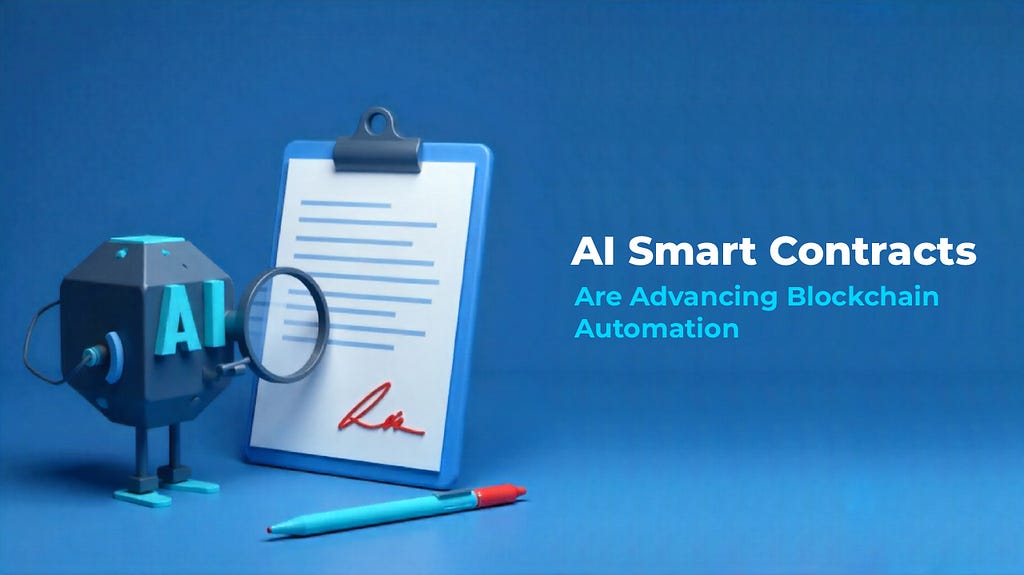
How AI Smart Contracts Are Advancing Blockchain Automation?

How AI Smart Contracts Are Advancing Blockchain Automation?

How AI Smart Contracts Are Advancing Blockchain Automation? The fusion of artificial intelligence (AI) and blockchain technology marks a new era in digital transformation. While blockchain provides trust, transparency, and immutability, AI brings intelligence, adaptability, and prediction. Together, they give rise to a groundbreaking innovation — AI Smart Contracts. These intelligent contracts are reshaping automation in blockchain networks, making transactions faster, smarter, and more secure than ever before. In this comprehensive guide, we’ll explore how AI smart contracts work, their architecture, benefits, and their role in advancing blockchain automation for businesses, developers, and decentralized systems worldwide.

  1. The Concept of AI Smart Contracts Explained A smart contract functions as an automated blockchain protocol executing predefined terms. It automatically enforces terms when predefined conditions are met, removing the need for intermediaries. However, traditional smart contracts have limitations — they lack reasoning ability, adaptability, and dynamic decision-making. That’s where AI Smart Contracts step in. By integrating AI algorithms, machine learning models, and natural language processing into blockchain environments, these contracts gain the ability to analyze data, make context-based decisions, and evolve over time. Instead of static rule execution, they enable intelligent automation — capable of understanding real-world variables and adjusting accordingly. For example, an AI-powered insurance contract can analyze weather data, accident reports, or claim histories to determine fair settlements instantly without human review.
  2. How AI Smart Contracts Work AI Smart Contracts combine the logical structure of blockchain with the computational intelligence of AI models. Here’s how they typically function: Data Input Layer — External data feeds (via oracles) supply real-time information such as prices, IoT data, or user behavior into the contract.AI Processing Layer — AI algorithms interpret this data, predict outcomes, and trigger specific contract conditions based on learned patterns.Execution Layer — Once conditions are met, blockchain executes the transaction securely and immutably.Feedback and Learning Layer — The AI model continues learning from outcomes, improving future decision accuracy. This loop enables contracts to evolve — moving from “if-this-then-that” logic to adaptive, autonomous execution.
  3. The Role of AI in Blockchain Automation Automation has always been blockchain’s strength. However, with AI, this automation becomes dynamic and context-aware. Traditional blockchain systems follow deterministic logic — they execute predefined conditions without flexibility. AI introduces reasoning, enabling the blockchain to automate complex processes such as: ★Fraud detection and prevention ★Predictive pricing in decentralized exchanges ★Supply chain optimization ★Automated compliance and auditing ★Risk assessment in DeFi lending This advancement allows blockchain networks to move beyond static automation into intelligent automation, where contracts can process real-world complexity.
  4. Key Components of AI Smart Contract Architecture AI Smart Contracts integrate several technological layers to operate effectively: Blockchain Layer — Provides decentralization, immutability, and trust for recording transactions.Smart Contract Layer — Defines logic, conditions, and functions for contract execution.AI Model Layer — Embeds algorithms or connects with AI APIs to analyze and predict outcomes.Oracle Layer — Bridges off-chain data to on-chain smart contracts securely.Data Storage Layer — Stores AI model outputs and relevant training data for continuous learning. This multi-layer design ensures that AI insights directly influence automated decisions within blockchain ecosystems.
  5. Advantages of AI Smart Contracts The integration of AI within smart contracts unlocks several powerful benefits: a) Intelligent Decision-MakingAI algorithms allow contracts to interpret complex inputs and act intelligently rather than rigidly following pre-set logic. b) Predictive AutomationAI smart contracts can predict trends, outcomes, and risks based on historical and live data — allowing proactive decision-making. c) Improved EfficiencyBy automating analysis and execution, businesses save time and reduce operational bottlenecks. d) Enhanced SecurityMachine learning models detect anomalies or potential frauds, helping strengthen blockchain’s existing security mechanisms. e) Dynamic Contract AdjustmentAI can modify contract conditions in real time, adapting to new data or market fluctuations. f) Reduced CostsAutomation of complex processes eliminates intermediaries and manual interventions, lowering transaction and management costs. g) Continuous LearningUnlike traditional contracts, AI smart contracts evolve with data, improving their accuracy and performance over time.
  6. AI Smart Contracts in Action: Use Cases Across Industries
  7. Decentralized Finance (DeFi)AI Smart Contracts enhance lending, yield farming, and trading by predicting price fluctuations, managing risks, and optimizing liquidity pools automatically.
  8. Insurance AutomationAI-powered insurance contracts assess risk, validate claims, and trigger instant payouts using AI-based verification of off-chain data sources.
  9. Supply Chain ManagementBy analyzing IoT sensor data, AI smart contracts monitor goods in real time, verify authenticity, and automatically release payments upon verified delivery.
  10. Real Estate TokenizationAI ensures transparent property valuation, predictive pricing, and automated escrow management for tokenized assets on blockchain networks.
  11. Healthcare Data ManagementAI Smart Contracts automate access control, consent management, and data sharing between healthcare providers while maintaining patient privacy.
  12. Energy TradingIn renewable energy systems, AI smart contracts balance supply-demand ratios, automate billing, and manage peer-to-peer energy exchanges efficiently.
  13. Gaming and NFTsAI agents within smart contracts personalize in-game economics, manage NFT royalties, and prevent fraudulent asset duplication.
  14. Governance and VotingAI Smart Contracts can analyze voting behavior, identify irregularities, and ensure transparent and secure DAO governance.
  15. How AI Improves Traditional Smart Contracts Traditional smart contracts operate on deterministic rules: if X happens, then execute Y. While effective for predefined logic, this approach fails in uncertain or data-rich environments. AI adds several layers of sophistication: By merging the two technologies, blockchain systems evolve into autonomous economic agents, capable of handling complexity at scale.
  16. Challenges in AI Smart Contract Adoption While AI Smart Contracts offer remarkable potential, several challenges remain: Data Reliability — AI depends on accurate data inputs; unreliable oracles can lead to false outcomes.Computational Costs — Running AI models on-chain can be expensive; hybrid models (off-chain AI + on-chain verification) are often needed.Transparency Issues — AI’s decision-making process can be opaque, complicating trust verification in decentralized ecosystems.Security Risks — AI model manipulation or data poisoning could lead to incorrect contract execution.Regulatory Concerns — Governments are still catching up to AI’s integration with decentralized systems, raising compliance questions. These hurdles, though significant, are gradually being addressed through innovations in AI explainability, zero-knowledge proofs, and decentralized data oracles.
  17. The Future of Blockchain Automation with AI As AI continues to mature, its synergy with blockchain will create autonomous digital ecosystems capable of running complex operations without human input. Future smart contracts will not just execute predefined conditions but will also: ★Negotiate and amend contract terms automatically ★Analyze real-time global data to optimize outcomes ★Interact with other AI agents for multi-contract coordination ★Handle cross-chain transactions intelligently These self-learning blockchain environments could give rise to fully autonomous organizations (AOs) — businesses operated entirely by AI-driven smart contracts that make decisions, execute strategies, and manage assets transparently.
  18. Strategic Business Benefits of AI Smart Contracts For enterprises, integrating AI Smart Contracts brings measurable business advantages: Faster Decision Cycles: Real-time analytics enable rapid business responses.Optimized Operations: Automation minimizes manual overheads and errors.Increased Profitability: AI-driven insights lead to smarter pricing and higher ROI.Better Risk Management: Predictive models prevent losses and ensure compliance.Enhanced Trust: Blockchain’s transparency combined with AI’s intelligence ensures reliable digital transactions. These capabilities help organizations transition from reactive operations to proactive, self-optimizing business ecosystems.
  19. The Path Ahead for Developers and Innovators Developers building AI Smart Contracts must balance decentralization with computational practicality. Emerging trends include: Hybrid Architectures: AI models run off-chain, while blockchain verifies outputs.Federated Learning: AI learns collaboratively across nodes without sharing raw data.Explainable AI (XAI): Increases transparency in AI decision-making within smart contracts.Quantum-Safe AI Contracts: Prepare for next-gen cryptographic security in automation. Such advancements are paving the way for more efficient, scalable, and transparent blockchain ecosystems. Conclusion AI Smart Contracts represent the next frontier in blockchain automation. By merging the trust and transparency of blockchain with the intelligence and adaptability of AI, businesses gain systems that not only execute transactions but understand context, predict outcomes, and continuously optimize processes. As this fusion deepens, blockchain networks will evolve into self-governing digital infrastructures — capable of managing entire economic systems without human intervention. The future of blockchain automation is not just decentralized — it’s intelligent, predictive, and autonomous. AI Smart Contracts aren’t just advancing blockchain automation — they’re redefining how the digital economy operates.
How AI Smart Contracts Are Advancing Blockchain Automation? was originally published in Coinmonks on Medium, where people are continuing the conversation by highlighting and responding to this story

Author: Medium
Which Crypto to Buy Today for Long-Term Gains? A Utility Token Targeting $3 Post Listing

Which Crypto to Buy Today for Long-Term Gains? A Utility Token Targeting $3 Post Listing

The post Which Crypto to Buy Today for Long-Term Gains? A Utility Token Targeting $3 Post Listing appeared first on Coinpedia Fintech News Investors in the crypto market are always searching for the next big crypto that brings both innovation and stability. In 2025, one project is drawing serious attention for its blend of real-world use and long-term potential — Mutuum Finance (MUTM). Built as a decentralized lending protocol, it is developing a foundation that promises steady demand, …

Author: CoinPedia
Oku Morpho Etherlink Launch: How a 3,300% TVL Surge Changes Tezos DeFi Forever

Oku Morpho Etherlink Launch: How a 3,300% TVL Surge Changes Tezos DeFi Forever

Oku deploys Morpho's $10B lending protocol on Etherlink. Can Tezos L2 compete with Ethereum DeFi through MEV Capital's USDC vault?

Author: Hackernoon
SoFi Crushes Earnings as Record Quarter Drives Shares Higher on Tuesday

SoFi Crushes Earnings as Record Quarter Drives Shares Higher on Tuesday

TLDR SoFi posted Q3 revenue of $961.6M, beating estimates by 7.4% and growing 38% year-over-year The company added a record 905,000 new members in the quarter, bringing total members to 12.6 million Loan originations hit a record $9.9B, up 57% year-over-year, with personal loans reaching an all-time high Fee-based revenue jumped 50% to $409M, showing [...] The post SoFi Crushes Earnings as Record Quarter Drives Shares Higher on Tuesday appeared first on Blockonomi.

Author: Blockonomi
Myriad Expands Prediction Markets to BNB Chain with Automated Features and Asian Localization

Myriad Expands Prediction Markets to BNB Chain with Automated Features and Asian Localization

The post Myriad Expands Prediction Markets to BNB Chain with Automated Features and Asian Localization appeared on BitcoinEthereumNews.com. COINOTAG recommends • Exchange signup 💹 Trade with pro tools Fast execution, robust charts, clean risk controls. 👉 Open account → COINOTAG recommends • Exchange signup 🚀 Smooth orders, clear control Advanced order types and market depth in one view. 👉 Create account → COINOTAG recommends • Exchange signup 📈 Clarity in volatile markets Plan entries & exits, manage positions with discipline. 👉 Sign up → COINOTAG recommends • Exchange signup ⚡ Speed, depth, reliability Execute confidently when timing matters. 👉 Open account → COINOTAG recommends • Exchange signup 🧭 A focused workflow for traders Alerts, watchlists, and a repeatable process. 👉 Get started → COINOTAG recommends • Exchange signup ✅ Data‑driven decisions Focus on process—not noise. 👉 Sign up → Myriad, a leading prediction market protocol, has launched on BNB Chain, introducing Automated Markets for rapid 5-minute trading and full ecosystem integration. This expansion targets millions of new users in Asia with Mandarin localization and native bridging, enhancing accessibility and speed in crypto predictions. Myriad’s BNB Chain integration brings prediction markets to the BNB ecosystem, supporting EVM wallets and automated resolutions. Automated Markets enable continuous 5-minute price action with instant auto-resolution for simpler user participation. The launch includes upcoming Mandarin-language support and localized experiences, expanding Myriad’s reach in Asian markets with over 200 million potential users. Discover Myriad’s BNB Chain launch: Faster prediction markets, Asian localization, and automated trading arrive. Explore how this boosts crypto accessibility today. What is Myriad’s Launch on BNB Chain? Myriad’s launch on BNB Chain marks a significant expansion for the prediction market protocol, integrating it into the BNB ecosystem to serve millions of users, particularly in Asia. This move follows deployments on Abstract and Linea, enabling EVM wallet sign-ins, native bridging, and new Automated Markets for quick, auto-resolving predictions. It underscores Myriad’s commitment to…

Author: BitcoinEthereumNews
Top Crypto To Buy: Can Ripple (XRP) Build Steady Ground, As Mutuum Finance’s (MUTM) Emerging Prominence Sees Its Presale Phase 6 Close To Selling Out?

Top Crypto To Buy: Can Ripple (XRP) Build Steady Ground, As Mutuum Finance’s (MUTM) Emerging Prominence Sees Its Presale Phase 6 Close To Selling Out?

Ripple (XRP) has faced persistent headwinds lately. Traders watched it drop 1.31% in the past day, hovering at $2.38 amid broader market jitters. US-China trade frictions escalated. Thus dampening global risk sentiment and pushing investors toward safer havens.  Meanwhile, a US government shutdown stalled SEC progress on XRP’s spot ETF approval. This has injected fresh [...] The post Top Crypto To Buy: Can Ripple (XRP) Build Steady Ground, As Mutuum Finance’s (MUTM) Emerging Prominence Sees Its Presale Phase 6 Close To Selling Out? appeared first on Blockonomi.

Author: Blockonomi
The reason new crypto ETFs launched despite the U.S. government shutdown

The reason new crypto ETFs launched despite the U.S. government shutdown

The latest round of spot crypto ETFs went live on major exchanges, advancing under existing SEC rules despite the U.S. government shutdown. NYSE opens the door to new crypto ETFs On Oct. 27, the New York Stock Exchange quietly marked…

Author: Crypto.news